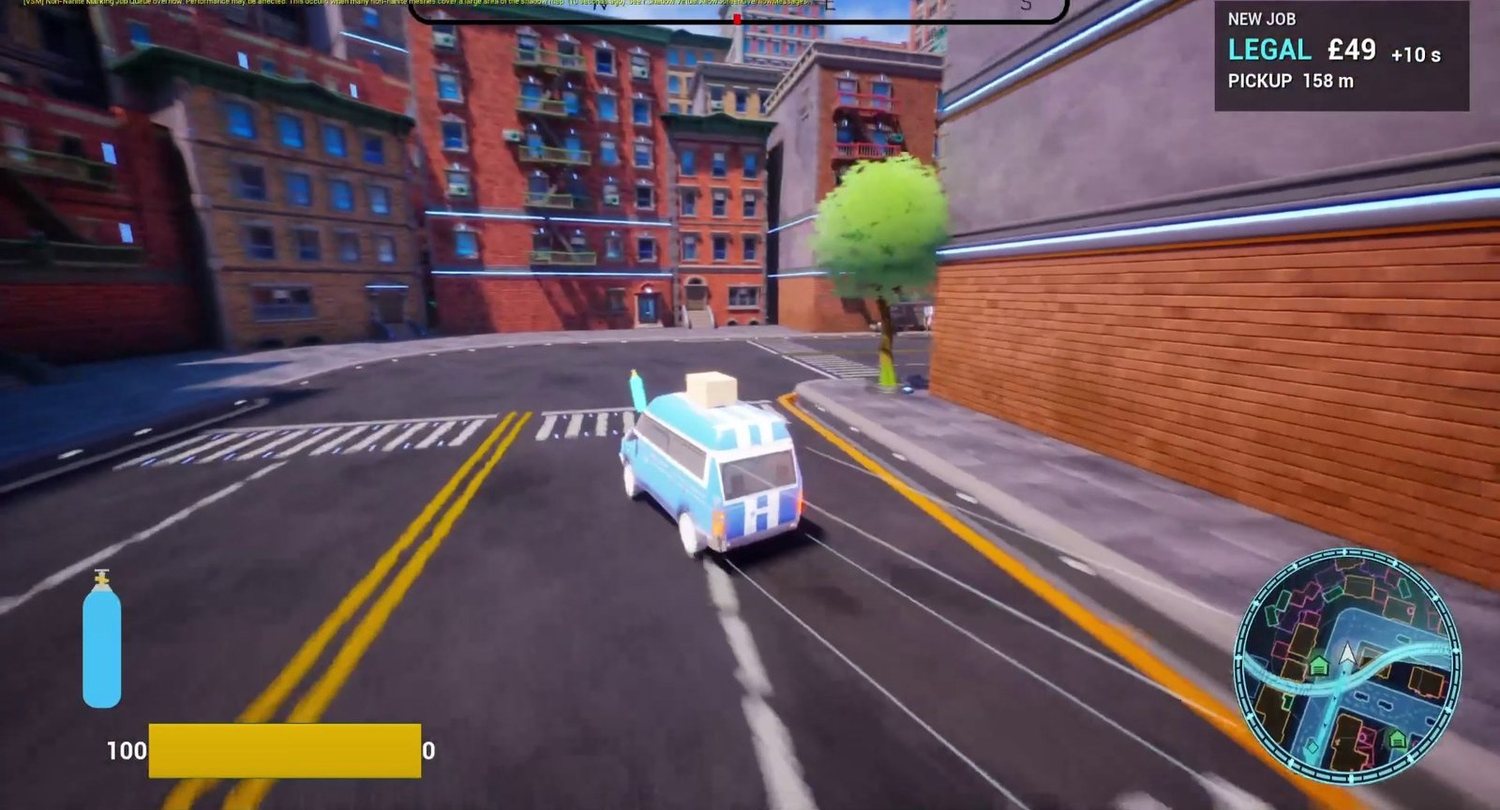
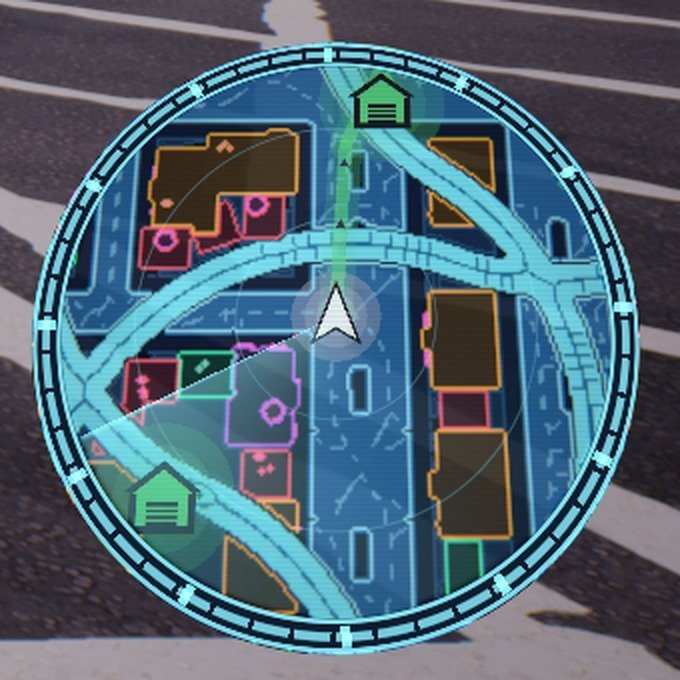
The courier's HUD: the job panel top right, the radar bottom right with the route to the pickup, nitro and health bottom left
The HUD (heads-up display: the gauges and panels drawn over the game) tells each player what they need while driving fast. Its centre is the radar, a round holographic map that turns with the car, routes the courier to the job and decides what the police know about the van. The radar matters more than any other screen element, because in an asymmetric chase what each side can see is the game.
Everything in the build
Feature
What it does for play
Blueprint nodes
Ieuan reads nitro, health, net and heat with no code
HUD panel slots
Each panel is its own widget, shown to courier, police or both
City map built at round start
The city measured from above once, drawn as a flat picture
Holographic radar
Round, turns with the car, zooms out with speed
Radar moods
Glitches with damage, pulses red and blue as police close in
GPS routes
A glowing route to the job, plus a faint one to a garage when damaged
Alley paths
Alleys the level designer marks by hand, drawn and routed on the radar
Heat on the police radar
Search circles and late sightings instead of a live van
How heat works on the radar
"Heat" is how much the police know about the van. It depends on the cargo, which Abdullah designed with three tiers:
Cargo
What the police radar shows
What the courier sees
Legal
Nothing
Nearby police, as always
Illegal
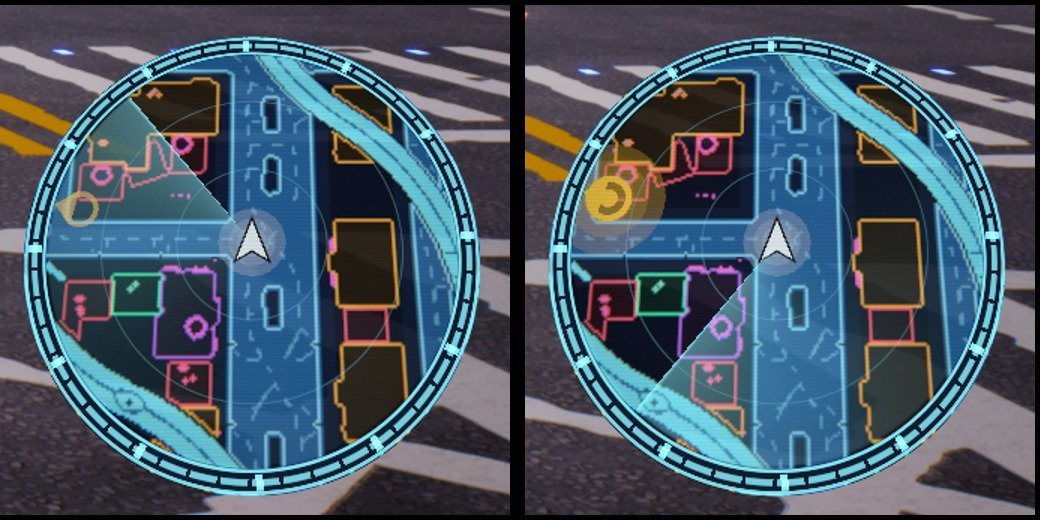
A search circle every 6 s, never centred on the van, shrinking from 60 m to 25 m
The rim flashes red on each ping
Hot
A pulsing blip that updates each second, 1.5 s behind
The same rim warning
Any, when seen
A pink-red diamond, then a fading "last seen" cross
A spotted warning, a HUD hook for Ieuan
The van and every clue to it are hot pink-red. Abdullah's reason: yellow is neutral and does not say "catch him", and plain red would be lost among the cops' red and blue.
From the build
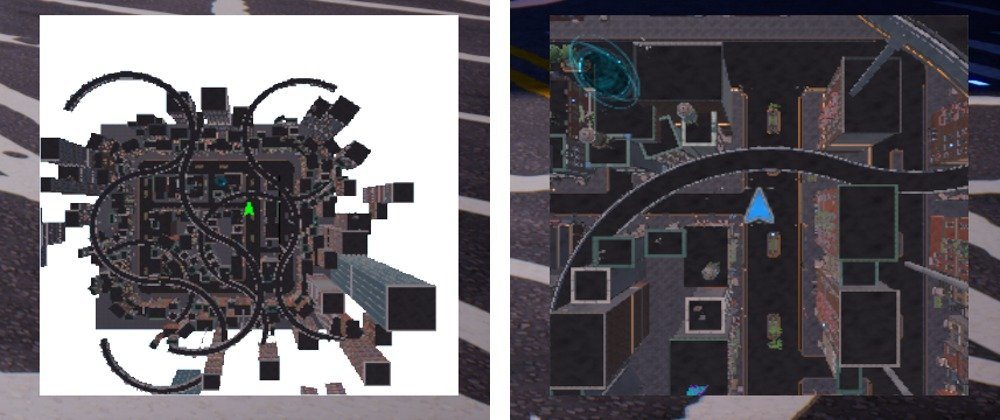
The prototype's radars, a live camera above each car: the van's (left) and the police's (right)
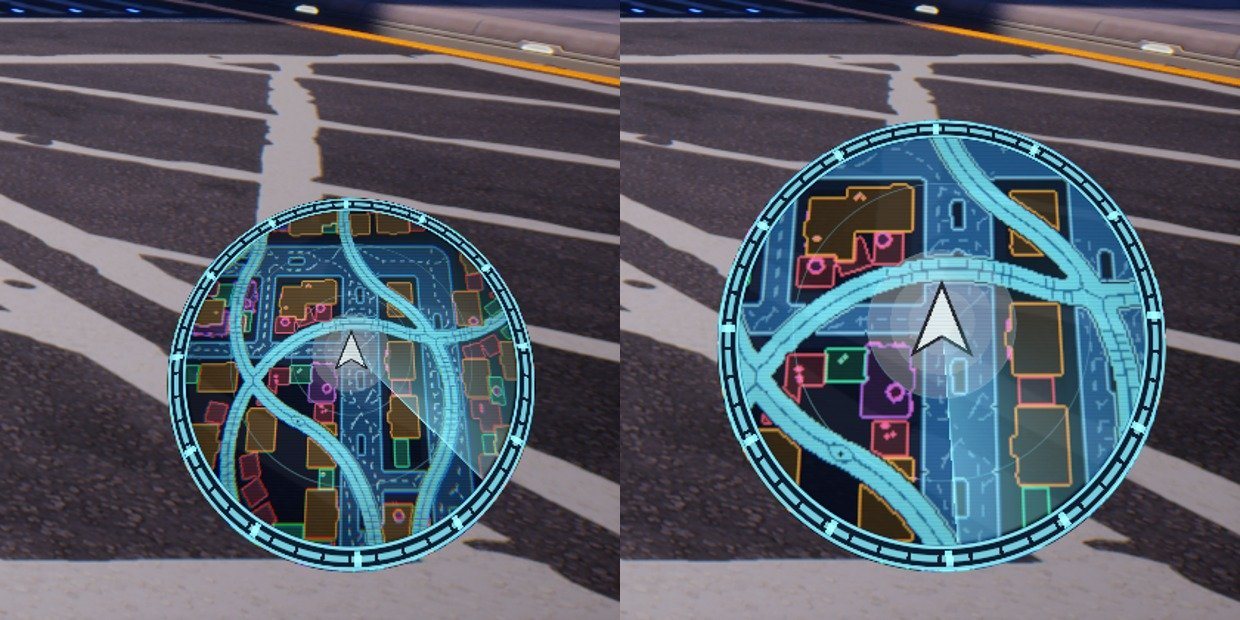
The readability pass Abdullah asked for: before (left) and after (right)
Police radar with the van out of sight: an illegal-cargo search circle on the rim (left) and a hot-cargo blip (right), in early colours
A damaged courier routed in faint green to the nearest open garage, drawn as a small garage
Each radar stage was captured in the game at the same spot, from the old camera radar to the final one. Abdullah drove it after every pass. Heat was tested with two instances: a server as the courier and a client as a cop, with the van moved out of sight on the server. Abdullah then played it with three players and called sightings and last seen "much better now".
Wiki / Behind the design / HUD, radar & routes
Behind the design
Why hud, radar
Built 22 Oct to 30 Oct 2026 · Who Abdullah (code, radar design, testing), Ieuan (HUD widgets and radar frame)
What we set out to do
Ieuan owns the UI and builds it in Blueprint (Unreal's visual scripting), so the first goal was to let him build every panel with no C++ and no programmer time. The second goal came from Abdullah: a radar that looks and works like GTA's. Ieuan agreed to hand the radar over to him. The prototype's radar was a live camera above each car, which was costly and hard to read.
The big decisions
Full comparison: Trade-off Appendix.
Option
Pros
Cons
Verdict
A map of the city built at round start, drawn flat
Costs almost nothing per frame; can be styled freely
A builder to write
Chosen
A camera rendering the city (the prototype)
Exact
Drew the city again every frame on every car; hard to read
Rejected
Measuring the city showed it was drawn twice a frame, once for the screen and once for the radar camera (see the City chapter). The built map removed that cost and freed the look. Buildings are coloured by "family" (the pack's building types) because the pack's real roofs are all grey concrete. Abdullah felt a grey map was "soulless" for a colourful game.
Option
Pros
Cons
Verdict
Police never see the van live; sightings 1 s late
Breaking line of sight is a real escape
Cops must work together
Chosen
Live while any cop can see it (150 m)
Easy for the police
The van was almost always shown; hiding was pointless
Rejected
Abdullah noticed in his test that the police could see the van nearly all the time. The sight range was 150 m, but the police radar only shows 55 to 85 m round the car. Any van on the radar was almost always in some cop's sight. Now a cop sees the van within 80 m in a 100 degree cone in front, or 40 m all round. The team gets a sighting that moves every 1.5 s and sits 1 s behind.
Playtesting and what changed
Date
Who played
What they found
What we changed
26 Oct
Abdullah
The first hologram was too far out and too busy
Closer zoom; roads stand out over buildings; calmer effects
27 Oct
Abdullah
The sweep spun "a million miles per hour" on nitro
The sweep is moved on each frame instead of worked out from the clock
27 Oct
Abdullah, three players in the editor
One cop saw the other cop's radar
Each player's radar draws into its own picture
27 Oct
Abdullah
Garage blips were "massive"
About a third smaller
27 Oct
Abdullah
The police could see the van nearly all the time
No live van; cone and all-round sight ranges
27 Oct
Abdullah
Red SPOTTED and PING text looked like debug text on the map
Removed; the HUD shows warnings from Blueprint nodes
30 Oct
Uni playtest, written up by Abdullah
Radar too busy; job and garage routes too close; compass not needed
Plain grey buildings; thinner garage route beside the job; compass passed to Ieuan
The sweep fix is worth explaining. The radar material worked the angle out as "time since the start, divided by the time for one turn". Nitro shortens the turn from 3.2 s to 1.4 s. Every small change therefore moved the angle by an amount based on the whole match so far, and the longer the match, the worse the jump.
Problems and fixes
Problem
Cause
Fix
The streets were missing from the map
A clutter filter hid names containing "tree", and "street" contains "tree"
Streets are never clutter
The radar stayed square, with a dark box behind it
The project's newer material system ignores the old UI opacity input
A UI node made for the newer system
Automatic alley finding caught open ground and slabs in the void
Any flat ground at street level counted
Dafydd marks each alley by hand with an alley path
A damaged courier with a parcel never saw the garage route
The job route always took priority
Both routes drawn; the job on top, the garage faint green
A first Level Blueprint widget crashed with "Accessed None"
The server runs the level too and has no screen
Widgets live in HUD slots, which only exist on players' PCs
The alley change was Abdullah's question: was there a better way that Dafydd could work with while building the level? A hand-placed path is exact, and moving a building never changes it. To judge it, Abdullah had a proper test alley cut through one block of the sandbox city.
Lessons
Look at a HUD element in the game at the size players see it, not on a test image.
Never multiply a clock by a speed that changes; move the position on each frame instead.
When the level designer knows the answer, let them mark it rather than guessing from the geometry.
Latest
Date
What changed
Why
27 Oct 2026
Heat on the police radar; no live van
Hiding has to be a real escape
27 Oct 2026
Job and garage routes shown together; warning text moved to the HUD
A damaged courier has a real choice to make
29 Oct 2026
Radar draws the whole connected street network
Streets at the edge of Dafydd's bigger city were cut off
 Shady Shipping